

Farewell to the Flying Panther: IAF Retires Iconic MiG-21 After Six Decades of Supersonic Glory
Air show Chandigarh 2026,
Chandigarh, September 26 :
India’s first supersonic fighter jet, the legendary MiG-21, roared into history today as the Indian Air Force (IAF) bid it a ceremonial farewell at Chandigarh Air Base—the very place where it first landed in 1963. Air Chief Marshal Amarpreet Singh took the jet’s final sortie, marking the end of an era for a machine that defined Indian air power for more than 60 years.
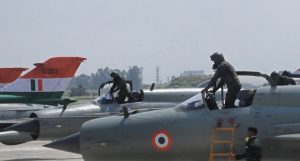 Defence Minister Rajnath Singh, the chief guest, called the MiG-21 “a symbol of the deep bond between India and Russia” and hailed it as a witness to countless acts of heroism. “From the 1971 war to the Kargil conflict, from the Balakot air strike to Operation Sindoor, there was never a moment when the MiG-21 did not give our armed forces unmatched strength,” he said.
A Historic Journey of MIG 21
First Squadron & Leadership: The IAF inducted its first MiG-21 squadron in 1963 under the command of Dilbagh Singh, who later became Air Chief in 1981.
Production Legacy: One of the world’s most widely produced supersonic fighters, over 11,000 MiG-21s served in more than 60 countries. India alone acquired over 870 aircraft—now just 36 remain.
Four Defining Victories
1. 1965 War: After the 1962 setback against China, India strengthened its air power with the MiG-21. In the 1965 war, its speed and firepower forced Pakistan to its knees.
2. 1971 Liberation of Bangladesh: On 14 December 1971, MiG-21s bombed the Governor’s House in Dhaka, prompting the governor’s resignation. Two days later, Pakistan surrendered and 93,000 soldiers laid down arms.
3. Kargil, 1999 – Operation Safed Sagar: The MiG-21 proved its mettle in the high-altitude battles of Kargil and shot down a Pakistani Atlantic reconnaissance aircraft.
4. 2019 Balakot Aftermath: During Pakistan’s retaliatory strike following India’s Balakot air raids, a MiG-21 Bison shot down a Pakistani F-16—its last combat kill.
Glory and Peril
The MiG-21 was upgraded repeatedly, with the Bison variant carrying modern radar and missiles. Yet its age showed: dubbed the “Flying Coffin,” the jet was involved in over 300 accidents, claiming the lives of more than 170 IAF pilots and 40 civilians. Between 1966 and 1984 alone, more than half of India’s 840 MiG-21s were lost in crashes. In the last four years, seven more went down, including:
5 Jan 2021: Suratgarh, Rajasthan – Pilot ejected safely
17 Mar 2021: Near Gwalior, MP – Group Captain killed
20 May 2021: Moga, Punjab – Pilot killed
25 Aug 2021: Barmer, Rajasthan – Pilot survived
25 Dec 2021: Rajasthan – Pilot killed
28 Jul 2022: Barmer – Two pilots killed
8 May 2023: Hanumangarh, Rajasthan – Pilot ejected safely
Final Salute
The MiG-21’s operational farewell flight took place on 25 August 2025 at Nal Air Base, Bikaner. Today’s ceremony at Chandigarh was a poignant full-circle moment: the jet first touched Indian soil here in 1963, and here it bows out.
With technology advancing and maintenance becoming a challenge, the IAF is now shifting to next-generation fighters such as the indigenous Tejas, Rafale, and Sukhoi-30 to defend India’s skies.
As the “Panther” retires to museums, it leaves behind a legacy of unmatched speed, daring missions, and six decades of service that lifted the nation’s pride to supersonic heights.